
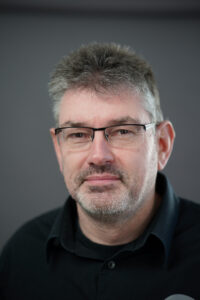
I was born in Cologne, Germany, in 1967. I studied photographic technology at the University of Applied Sciences in Cologne and received my engineering degree (Diplomingenieur) in January 1992.
As a scientific engineer, I worked at the Institute for Light and Building Technology at the University of Cologne, where I developed holographic optical elements for facades that optimize sunlight use in buildings to decrease energy consumption.
After establishing a digital workflow at a prepress company, I started my own business in 1995 (Image Engineering Dietmar Wüller), offering courses and training on image capture and processing. This work led to my writing for photographic magazines, focusing on digital image capture devices, image quality, and color management. In 1998, I published a book on digital photography, Digitale Fotografie (Springer Verlag, ISBN 3-540-62887-8), written in German.
In 1997, I established the world’s first independent testing laboratory for digital cameras to measure their physical characteristics, such as resolution and dynamic range. The idea originated with my first customer, the popular German photography magazine Color Foto. Shortly after it was opened, many engineers from various camera manufacturers, including Canon, Nikon, and Leica, showed up to find out what I was doing. In 1998, the test procedure was extended to include photographic scanners, which were also very popular at that time.
In 1999, when Leica began collaborating with Panasonic, both companies visited our lab and ordered a test stand based on ours. Previously, Leica had collaborated with Fujifilm, but they could not agree on camera specifications and tolerances because they tested cameras differently. Leica did not want the same thing to happen with the new partnership.
To stay up to date on developments in image quality evaluation and integrate test procedures into ISO and national standards, I joined the German standards organization DIN. Since 2001, I have chaired the German national body on digital photography standardization. Currently, I lead the groups for cultural heritage digitization and machine vision within the ISO Technical Committee 42 for Photography, and I have edited more than a dozen photography standards.
Since 1989, I have been a member of the Society for Imaging Science and Technology (IS&T) and have served on the board for many years. I am also a member of the German Photographic Society (Deutsche Gesellschaft für Photographie e.V., DGPh) and have published numerous papers on digital camera evaluation and digital imaging at international conferences such as EI, PICS, CIC, and Archiving, for which I have received multiple best paper awards. In January 2026, I was inducted into the Hall of Fame of the German Photo Presse.
In 2000, Image Engineering added consulting and support on archiving digital images and documents to its portfolio. Projects included digitizing historic books written from the 6th to 12th centuries from the Dom und Diözesanbibliothek in Cologne (a Catholic library); digitizing the manuscripts of Heinrich Heine, a famous German poet; and digitizing „incunabula“ books printed between 1450 and 1500.
From 2002 until 2017, I was also a publicly certified expert on digital photography, scanning, and image processing in Germany. Due to my workload at Image Engineering, I decided to stop that work in 2017.
Over the years, my company, Image Engineering, has grown into one of the world’s leading suppliers of test equipment for cameras. We have more than 50 employees, distributors worldwide, and subsidiaries in China and the USA. Based on my ideas, we developed image quality evaluation software and a very stable, spectrally tunable light source with 34, and later, 41 channels. These channels cover the range from ultraviolet (UV) light (starting at 365 nm) and visible light (380–780 nm) to near infrared (NIR) light (780–1050 nm) and shortwave infrared (SWIR) light (up to 2300 nm). We measure the spectral sensitivities of digital cameras using interference filters or the spectral light source with devices that are much simpler to operate than a monochromator. In 2024, I invented a way to print high dynamic range images with colleagues from CEWE, and it is now patented.
I am proud to say that no leading camera manufacturer in the world lacks at least one Image Engineering product, including the Tier 1 car manufacturers, which, in 2025, represented the largest market for Image Engineering. After leading Image Engineering as CEO for 30 years, I passed the position on to my successor, Nicola Best, in July 2025, and I will sell the rest of my shares in 2026. Currently, I still work for Image Engineering as a consultant, helping wherever I can without hindering progress.
The knowledge I’ve acquired over the years may be helpful to others as well, so I’ve decided to offer my services as a consultant, especially to the cultural heritage community.
So, here I am, willing to help.